How a solo studio ships at the velocity of a small team.
Every engagement runs through the same delivery pipeline: a lead orchestrator plans and decomposes the work, implementer agents write the code, and independent reviewer gates adversarially check it before anything is accepted. No agent approves its own work. The result is faster, more consistent delivery with adversarial QA built into the loop — not bolted on at the end.
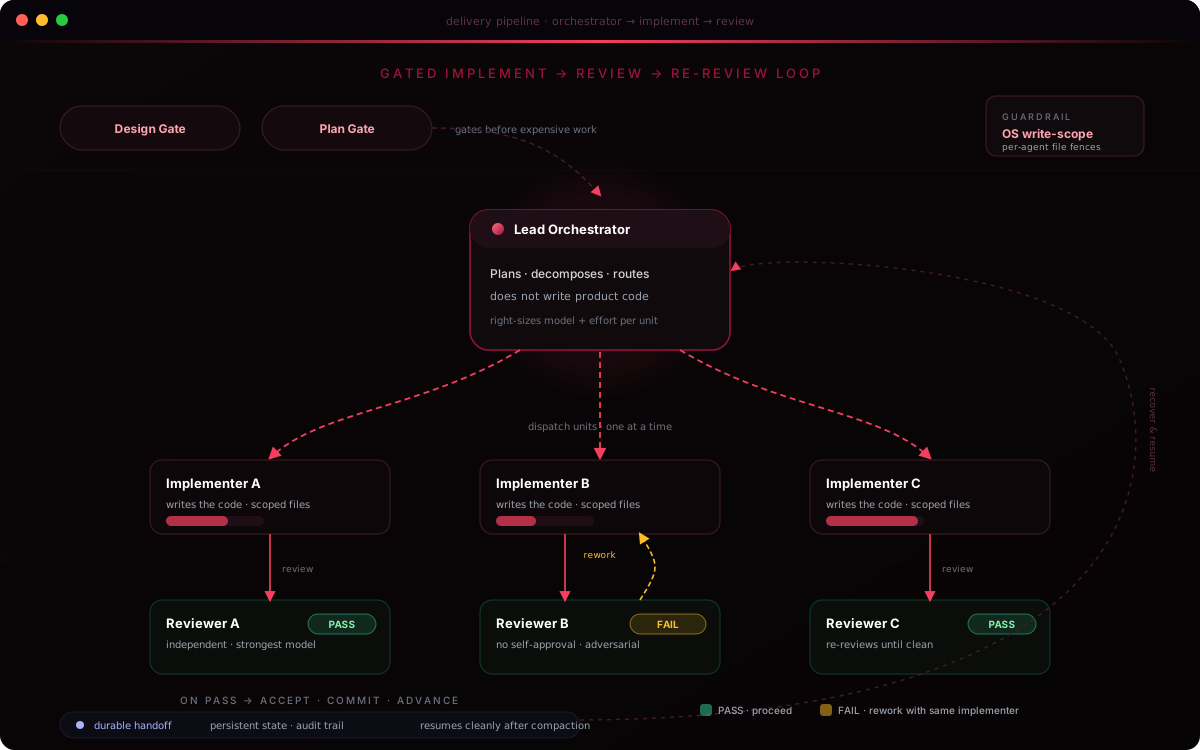
the gated implement → review → re-review loop, with durable handoffs across long sessions
One planner, many builders, an independent reviewer for everything.
At the center is a lead orchestrator. Its job is to understand the goal, break it into right-sized units of work, and route each one — but it deliberately does not write product code itself. Implementer agents take a single unit at a time and build it. Then a separate reviewer agent, which had no hand in writing the code, reviews it against the requirements adversarially: it is looking for the reasons to reject, not the reasons to approve.
On a PASS, the work proceeds. On a FAIL, it bounces back to the same implementer with the reviewer's findings, gets reworked, and is re-reviewed — and that cycle repeats until it passes cleanly. Because the author and the approver are never the same agent, nothing reaches the codebase on self-certification alone. It is the same separation-of-duties principle a careful team enforces with code review, applied consistently to every unit.
What keeps the velocity honest.
Gates before expensive work
Before any code is written, the design and the plan each pass through their own review gate. Catching a flawed approach at the design stage is cheap; catching it after a week of implementation is not. The gates exist to fail fast, on paper, before time and tokens are spent building the wrong thing.
Right-sized models per task
The orchestrator picks the model and the effort level to match each unit of work — a quick edit does not warrant the heaviest model, and a subtle architectural change does. Reviewer gates are the deliberate exception: they always run on the strongest model, because the cost of a missed defect is higher than the cost of the review.
Durable, compaction-safe handoffs
Long builds outlast any single working session. Plans, decisions, and the current position in the work are persisted to durable state, so progress survives long-running sessions and resumes cleanly rather than starting over. A handoff is a written record, not a fragile in-memory context that evaporates.
An audit trail of decisions
Plans, review outcomes, and the reasoning behind key decisions are recorded as the work proceeds. The trail makes the build inspectable after the fact — why a thing was done a certain way, what a reviewer flagged, what changed in response — which is exactly what a client needs to trust software they did not watch get written.
From goal to merged, one unit at a time.
The orchestrator turns the goal into a sequence of small, independently reviewable units, each with a clear definition of done. The plan itself passes a review gate before any work starts.
An implementer agent picks up a single unit and writes the code for it — scoped to just the files that unit owns, and nothing else.
A fresh reviewer that did not write the code checks it against the requirements, looking for defects, gaps, and shortcuts. It returns a clear PASS or FAIL with findings.
A failing unit goes straight back to the same implementer with the findings attached. It is reworked and re-reviewed — repeating until it earns a genuine PASS.
Only a cleanly reviewed unit is accepted and committed. Quality thresholds are enforced as a blocking gate, so 'done' means done, not 'probably fine'.
The orchestrator moves to the next unit, or writes a durable handoff so the work can resume later exactly where it left off — across sessions, runtimes, or context resets.
Guardrails that don't rely on the agent behaving.
Telling an agent "only touch these files" is a suggestion. Enforcing it at the operating-system level is a wall. Each agent runs with write access scoped to exactly the files its unit owns — anything outside that scope is denied by the environment, not by the agent's good intentions. An implementer cannot wander into unrelated parts of the codebase, and parallel agents cannot collide.
The same posture extends to the broader environment: sensitive files stay unreadable, and network and system access are constrained rather than assumed. The point is that the safety properties hold even when a prompt is imperfect — which, eventually, every prompt is.
Write scope is enforced
An agent can modify only its assigned files. Out-of-scope writes are blocked by the OS, not a prompt.
No collisions in parallel
Strictly disjoint file boundaries let multiple agents work at once without stepping on each other.
Secrets stay sealed
Credential and secret files are protected at the environment layer and never exposed to a build agent.
Runtime-portable
The same workflow shape runs across Claude Code and OpenAI Codex, so the method is not tied to one vendor.
A small team's throughput, with a reviewer watching every line.
The honest version of the pitch: this pipeline lets one founder move at a pace that normally takes several people, without giving up the thing that usually disappears when you go fast — review. Every unit of work is planned, built, and independently checked before it counts as done, and the whole build leaves an audit trail behind it. That is what makes "a solo studio" a credible answer to "who is going to maintain the quality of this?"
Have a problem worth
building software around?
Whether it is a custom build scoped to your operation or a fit for one of the studio's subscription products, the starting point is the same conversation. Tell us what is slow, manual, or breaking — we'll come back with a candid read on the best way to solve it.
Start the conversation →